

How Your Product Listings Could Be Costing You Traffic
- Nov 28, 2025
- 5 min read

By Central Station’s SEO Squad
TL:DR: AI tools and Amazon’s search engine are now your two biggest storefronts. If your product titles, schema, and listing data aren’t optimized, you won’t appear in Google’s AI answers or Amazon rankings. Fix the feed, fix the traffic.
For many shoppers, Amazon is the search engine for products. In fact, more than 6 in 10 (63%) consumers in key e-commerce markets start their online shopping searches on Amazon, rather than on Google. So, if you sell on Amazon (or even if you don’t, but compete with those who do), optimizing your product listings is critical.
You also can’t forget that AI is reshaping how shoppers discover products. Google’s AI Overviews and tools like ChatGPT now pull directly from product data.
Heads up:
There’s a NEW major AI shopping update across Google, just in time for the holiday season (blog.google)
ChatGPT now lets users shop without ever leaving the chat. (openai.com)
53% of consumers say they’ll use AI for shopping this year (Adobe, 2025)
If your Amazon listings and e-commerce pages aren’t sharp, structured, and keyword-rich, you're losing traffic to competitors who are. This guide covers why poor listings are killing your visibility, what "AI-ready" really means, and how to fix your feeds fast.
The Rise of AI-Powered Shopping

Image courtesy of Google.
Shoppers are embracing AI assistants for product research, recommendations, and even finding deals. This holiday season (think Black Friday, Cyber Monday, etc.), more people than ever will be querying AI tools for gift ideas and product advice.
For many product queries, Google’s AI can now generate a snapshot answer that directly features products, often showing a carousel of recommended items, with images, prices, and key details. In Google’s words, these “vertical experiences” provide curated product details right in the search results for commercial queries.
A new major update, just in time for the holiday season, allows users to:
Shop conversationally in search
Track prices with notifications to let them know when it’s on sale
Have Google call local stores on their behalf to find in-stock items
Meanwhile, OpenAI’s ChatGPT has gone a step further. ChatGPT not only recommends products in chat, but it now lets users buy products without leaving the chatbot. OpenAI introduced an “Instant Checkout” feature that shows relevant products from across the web and allows a user to tap “Buy” and complete a purchase entirely within the chat interface.
Why Poor Product Feeds Mean No Visibility
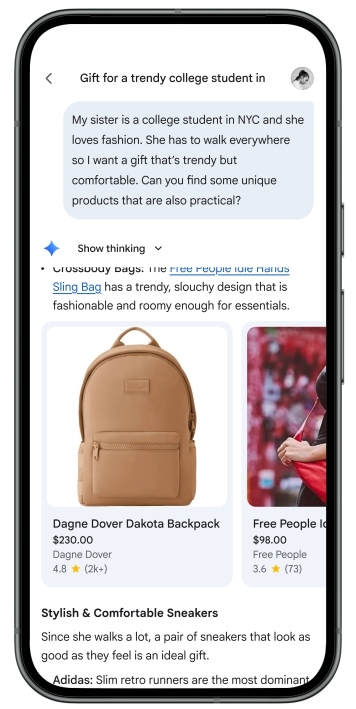
Image courtesy of Google.
Is your product info not showing up in AI search results or getting clicks? Why does that happen? The short answer is that AI-powered search algorithms are picky. They cherry-pick content that is well-structured, relevant, and trustworthy. A poor product feed (whether it’s your website’s schema, your Google Merchant feed, or your Amazon listing) sends weak signals to these algorithms.
AI search doesn’t play by the old SEO rules. Each AI system uses different signals; some heavily favour structured product data and up-to-date feeds, while others lean on factors like brand mentions or recent reviews.
Think of your product data as a data feed that AI systems consume. An optimized feed includes rich details: accurate titles with keywords, detailed descriptions, correct pricing and inventory, high-quality images, reviews, and structured data markup. These elements help AI understand exactly what you’re selling.
Tip: Use Google’s Rich Results Test to check your markup and use structured data like:
Product
Offer
AggregateRating
FAQ (for buyer question keywords)
Optimized Feeds = Higher Rankings, Clicks & Conversions
Don’t forget the paid side: even ad campaigns perform better with strong feed data. Google’s algorithms reward engagement, and a well-optimized feed (with compelling titles and images) can improve your shopping ad CTR.
More clicks at a lower cost means better ROI on your ad spend. It all traces back to feed quality. Think of your product being just as important as your ad bidding strategy.
A clear, keyword-rich title or a high-quality image in your feed can drastically improve performance. Shoppers scroll past irrelevant or unappealing listings, whether they’re in an AI answer or a traditional SERP.
Image courtesy of Giphy.

What happens if they land on a product page with sketchy or incomplete info? They bounce. In fact, a product content research report by Syndigo shared that 83% of global shoppers say they would abandon an e-commerce site if product information is insufficient, and 73% say they think less of the brand when product data is incomplete or inaccurate. Ouch.
On the flip side, having robust, consistent product data builds trust with both AI and human customers. It’s a win-win: you gain visibility, and you look credible when people arrive.
Amazon SEO Optimization & How to Drive Traffic With AI

Image courtesy of Amazon.
Amazon listing optimization for SEO is its own art and science. Amazon’s search algorithm looks at many factors, but two of the biggest are relevance and performance. Relevance is determined by your keywords and content; performance is determined by your sales history, conversion rate, and customer reviews.
You have direct control over the content side – things like:
Keyword-rich product titles
Complete, benefit-driven bullet points
Backend keyword fields with search terms (misspellings, variants)
Competitive pricing + A+ Content (if eligible)
→ Remember that Amazon’s A+ Content (if you have brand registry) isn’t indexed for search keywords, but it can boost sales by conveying your brand value and features visually.
If these aren’t fully optimized with the right keywords and info, your product will rank poorly in Amazon’s internal search results. Fewer people will find it organically on Amazon, which means fewer sales.
Don’t forget, it’s not just an internal Amazon issue; it spills over to external search and reputation. Amazon product pages often rank on Google for product-name queries. A weak Amazon listing (say, a vague title or scant description) = lost external traffic too.
So, an optimized Amazon page can create a virtuous cycle: higher Amazon ranking -> more visibility -> more traffic (both within Amazon and from outside) -> more sales.
Brand Reputation Management for Amazon Listing Optimization

Image courtesy of Amazon.
Lastly, manage your reviews and pricing. While this strays into the “operations” side, it’s part of optimization too. Competitive pricing and good reviews improve your Amazon search performance. If two listings have equally relevant keywords, Amazon is more likely to show the one with better conversion odds (i.e. a proven sales record and positive feedback).
Making Your Product Data AI-Ready: Free Checklist Download
Don’t let a poorly written listing or incomplete product info undermine your visibility. This is especially true during peak season, with millions of holiday shoppers are scouring Amazon, Google, and AI.
A few tweaks to your titles or keywords now can make the difference between your product being found or forgotten. So, here are the concrete steps you take to clean up and enhance your product data (in a quick checklist) to get you started:
Sound like a lot of work? It can be, but that’s where we come in. At Central Station, we specialize in making product data clear, structured, and compelling. We’ll help you implement all the above and more.
Our team can audit your product feeds and listings, pinpoint the gaps, and fix them so that Google’s AI and other search assistants can’t miss you. That includes adding rich schema markup on your site’s product pages, crafting keyword-optimized titles and descriptions, ensuring your pricing/inventory are accurate everywhere, and even managing your Amazon listings.


